
Hi everyone, it’s stormguard798, and welcome to the latest Weather Report. I don’t know about all of you, but the Expedition metagame had been an absolute maelstrom prior to the Expedition Open, shifting from one popular archetype to another, which made it incredibly amusing to prepare against. The addition of mini-set Stormbreak breathed life into pre-existing archetypes, and by that, I mean flooded the metagame with Feln and Menace based decks, just like in Throne. TEJ still had a great, albeit struggle-filled, time testing for the tournament, and the Open metagame ended up being appropriately diverse, leaving it nicely mixed up going into the draft pack changes (which honestly, didn’t end up doing too much to the format as a whole, which is a shame). Joining me in today’s Weather Report is the person I’m most often mistaken for and fellow Weather Council member, Stormblessed.
Hello y’all, it’s your favorite storm-related username here, Stormblessed (clearly the shade starts here). (SG: Bring it ON.) Some of you might have heard of me from my Top 4 performance at Worlds last year, or heard from me directly on FECast. It is quite a bit after the Expedition Open has ended, but I’m still pleased to be discussing the decklists therein through my invitation onto the Weather Report by the very generous Stormguard. I’d describe the current Expedition meta, especially pre-Open, as consisting of about seven Tier 1 decks, all with relatively comparable power levels.
This hypothesis is further supported by the Meta Report that the Misplay published for the Expedition Open, where no archetype, barring the Clone FPS Krull deck, over or underperformed. Every deck has a number of good solid matchups, while also suffering from one/two heinous ones and you just have to accept that. The other main feature of the format is that it’s warped and defined by two or three ends of the spectrum. That is to say, Rainbow Sling decks, Overloader Machinations Combo decks, and perhaps aggro decks in the vein of Hooru Soldiers and Mono Fire really do define the scope of what can go into each deck.
Stormguard’s deck:
Let’s be honest, after missing out on playing with those cards last Open, I was itching to digitally sleeve up some Grenahens and Crafty Occultists this tournament – both of them are incredibly powerful cards, and I certainly think playing both of them in some capacity is probably the way to go. #JustPlayTheGoodCards. I was torn between this and Overloader combo on which broken cards to pair with my bird and my boi, but ultimately landed on Sling. Whilst I had a fair amount of practice playing the combo deck, I felt the lines with Sling were a little more straightforward. 26 games is a lot to stay focused on, and as a person that tends to get burnt out very quickly, I elected to go with Rainbow Sling so that my brain isn’t completely fried, even though I do think Overloader is better at weathering its weaker matchups. As with the previous Open where the Menace Trove decks were an option, knowing yourself and what is physically possible for you to handle is also kind of important when picking a deck for Day 1.
[Editor’s note: You ended up on the same deck as the TRS folks again. Interesting. SG: Look, my Honey Milk Man and I have a simp-simpee relationship that transcends most forms of human communication. You wouldn’t understand.]
Credit to my teammate, AlexFiero, for coming up with our team’s initial iteration of 4F Sling, and to the Eternal Power calculator on Shifstoned.com for helping me out with the powerbase. >.< [Side note: if anyone would like to point me in the direction of a powerbase crafting article, I would greatly appreciate it. My powerbases are…something.] Going into this tournament, I was expecting the most popular decks to be Mono F, Sling, and Combo as being what I saw on ladder, so when building this deck, I definitely needed to have some kind of gameplan against them. Hooru Soldiers was fairly popular the previous week but the previously popular builds got fairly aggressively stonewalled by the more creature-oriented builds of Overloader Combo, so we didn’t expect to see it in huge numbers. We also expected to see smatterings of Mandrakes and JSx-based midrange. Unfortunately, with the nature of Sling being a more value-oriented, grindy deck, I think our combo-based matchup is just pretty poor no matter what we do. However, for Mono F, barring a quick Suppressor into Belax, I do think we should be able to stifle most of their aggressiveness and take over; the same applies to quick starts out of Soldiers – it’s hard to beat a double Dovid, but we should beat most reasonable draws. On the other hand, I feel quite good about the majority of our midrange and control matchups since Sling provides a fairly insurmountable volume of value, and with only Impound being a clean answer to our Sling, it’ll be rather tricky for most decks to get off the board.
There were quite a number of different builds of Rainbow Sling, so I wanted to discuss some card choices that I landed on, and how wrong I was in some cases. [Editor’s note: Hindsight might be 20/20, but Stormguard is just blind the majority of the time. Or just has a tendency to hyperfixate on things that don’t work. SG:…what am I supposed to say to that?]
Darkwater Vines/Shoaldredger:
Okay, let’s get the big one out of the way. I wasn’t confident enough in the powerbase to run multiple threats with double influence requirements – almost everyone else ended up running Slimespitter Slug, but I didn’t think that it was something you wanted 4 of at 6-cost, nor was it single influence. Hence, I kept the Darkwater Vines/Shoaldredger Package from the original Menace Sling list so that I had 16 Sling-able units maindeck. Darkwater Vines was also quite helpful as a cheap Regen blocker back when Soldiers was still popular.
That being said, the biggest issue was consistency. When you had Vines, you were able to get the Shoaldredgers cheaper quite quickly. When you didn’t, you weren’t able to fuel the Shoaldredgers easily enough with just Grenahen and Occultist, so they ended up rotting in your hand just a pinch too much. The more Vow heavy powerbase that everyone else was correctly running definitely helped enable the Vines more frequently, though it still isn’t terribly consistent. Even though they were powerful turns in the late-game where I could deploy multiple sling threats one after another, it didn’t make up for the fact there were just times that I couldn’t play my Shoaldredgers at all and just get completely run over. In a deck that ultimately is about consistently enacting a gameplan over and over again, it doesn’t quite cut it, but we didn’t come up with anything we liked better.
One other thing to consider is that Darkwater Vines being a symmetrical effect might also end up helping your opponent. After it got hit with an influence requirement, Krull may have been confined to Shadow decks, but with KWTHE and Whispering Wind both being Expedition legal, that’s certainly a strategy that we suspected quite a few people would be employing. The last thing you really want is to enabling their strategy as well, which is another knock against Vines/Shoaldredger as a strategy.
SB: For this deck I don’t think the Shoaldredger + Darkwater Vines paring isn’t quite good enough or synergizes enough. There’s just not enough ways to discard to consistently trigger Vines early enough (only 3! Crafty Lads!) and not quite enough ways to reliably make Shoaldredger cost 4 or less before the late game. 5 Cost Shoaldredger is just a sad Alhed, who is already a sort of do nothing on play card. I did try out a variety of Sling decks and while I did move off of them entirely, the version with these three cards (including Hourglass) was my least favorite.
One thing to note: earlier iterations had Rosebloom Mandrake as an additional Sling unit with Overwhelm as well, which is always nice. However… A. You have so little control over what ends up in your opponent’s void apart from Darkwater Vines discarding things, and therefore there wasn’t really any way to enable the Rosebloom Mandrake becoming cheaper. B. The spike in cost reduction was a huge factor. You’re content with playing Shoaldredger for 5 or 6 power sometimes, but the berth between 8 and 2 just introduced even more inconsistency in getting your Sling threats out.
Arcanum Hourglass:
Another fantastic payoff if you plan on self-discarding a fair amount. In a deck with plenty of card draw, if you can get even a few power cards into your void, you’ll be slamming multiple Sling-able units in a turn and be off to the races. The problem, however, arises when things don’t quite come together. You simply aren’t discarding a large enough volume of cards to even guarantee a single power card in your void on a regular basis – Darkwater Vines is good, but without cards like Sporefolk in the deck, it tends to just sight there and do nothing. The TRS and TIL builds have quite a few Vows to put Sigils into the void – I think that should be fine with regards to the dual-influence power situation should there be Trail Makers. However, the reality is that you aren’t running that many Sigils to begin with because you’re a 4.5F deck. In the end, the card just ended up varying so wildly for me and was pretty much dependent on whether I drew Vines or not that I didn’t think it worthwhile to include.
SB: I think that playing Vines/Dredger and not Hourglass is a mistake. But also that Hourglass is kind of meh. (I am definitely biased against Hourglass in a similar way to being biased against Whispering Wind). Not to say every deck playing Vines/Dredger needs Hourglass (see: Mandrakes), but a deck that wants to be playing expensive cards and also is playing Vines/Dredger doesn’t want Hourglass because there’s not enough self mill or discard… well that might be a sign that the deck also doesn’t want Vines or Dredger.
Trail Maker:
Oh, my precious influence-fixer. We end up cutting this card from the list because it got caught in the crossfire of Condemn, Salvo and Display of Menace a pinch too often, but that was a rather poor decision in hindsight. It felt bad that your power dork got removed and therefore disrupted your plans down the line, but if you were keeping a hand that relied on a unit living, then frankly that’s your own fault for keeping a sketchy hand. XD There is no shortage of unit removal in this format. Ultimately, even if your Trail Maker ended up trading 1 for 1, that is still quite worthwhile since you already got your influence, which is the part you care about. Definitely regretted not playing this multiple times on Day 1.
SB: ❤ Trail Maker you’ve been there for me since my Xenan Sites days. ❤
Spiritweaver:
The topic of a reasonable amount of discourse, I don’t think that it’s fair to compare this to Grenahen because I consider this to fulfil a different role in the deck – Grenahen looks to shore up your early game and make sure that you don’t get rushed by an aggressive draw; Spirtiweaver looks to help definitively close out the game by minimising the reach or any outs that aggressive decks may have. I will admit that they are both in the deck to combat aggressive decks and that Spiritweaver is a bit of a win-more card, but their roles diverge quite a bit. There are spots where it does stone-nothing, but the effect it provides is something I don’t think any other card in the format can quite do. It does become redundant in multiples, which is why I think 2 copies is a nice middle ground, but I think it’s definitely worth inclusion in the Sling lists – it has bailed me out quite a number of times, and works exactly the way you’d want it to with Somiel.
SB: This is actually a card I like as a 2 of honestly. It’s a bit situational, but it’s decent in a fair amount of situations. Having plunder means you can keep more hands and granting lifesteal means you can recover tempo and stabilize easier post Sling of the Chi. It can be somewhat awkward for the opponent to have in play so if they throw removal at this they aren’t using it on your more important cards. All that being said, it is still a situational 1/3 so I wouldn’t want too many copies of it and 2 copies seems like the perfect amount.
SB does bring up a fair point: you don’t have a lot of tiny units in the deck, and those that are (think Chicken and Crafty Boi) have already expended their summon effect and so it’s less worthwhile to hit those with removal. That means more often than not Spiritweaver is going to be an absolute magnet for cheap removal such as Vicious Overgrowth or Flash Fry. That being said, this card does fill a role that you need – considering how much nothing Sling decks tend to do in the early game, without a cheap sweeper like Hailstorm in Expedition, putting your beautiful life total out of range of a sneaky burn spell or charging flier often saves you from defeat. In a deck like Sling that tends to see a lot of cards, particularly once it gets going, 2-of seems like a fine number where you’ll likely see 1 copy most games.
Slimespitter Slug:
The secret piece of tech that quite a number of Sling players ended up bringing to the Open, it’s certainly an interesting option, though I’m not convinced it’s the best one. Admittedly, this deck does occasionally struggle with hordes of tiny fliers since you can typically only remove them 1 at a time: for instance, the bats from Syl or the Reapers from Rolant. It can also help incidentally recover some life in the process, and since you’re guaranteed to kill at least one thing with Sling out, it should be fairly straightforward to get this to 6 health as well for the draw trigger. I think the fact that our team’s list has 3 copies of Display of Menace definitely helped shore up our tiny flier situation quite a fair bit, but it’s certainly worth trying out as another Sling fatty since I’m shaving the Vines/Shoaldredger package.
SB: The not-so-secret piece of tech you mean! :p. Although it was actually a secret to me and I didn’t expect it so maybe I shouldn’t be talking. [SG: Same, honestly. The card wasn’t even on my radar.]
The removal suite (Send an Agent/Flash Fry/Suffocate/Permafrost):
I can’t believe it, but there are so many multifaction threats currently running around in the format that Send An Agent, my precious child, simply isn’t good enough to run as a 4 of – granted, it’s still an incredibly versatile removal spell, which is why we’re running 2 copies. [Editor’s note: And yet he still constantly runs the full 4 of Annihilate in Throne.] We considered diversifying our removal suite to better answer an assortment of threats, though we ended up simply running more value cards rather than additional interaction.
Earlier iterations of the deck had Flash Fry, in particular to deal with recursive Mandrakes as well as Grand Suppressor, but seeing an assortment of Soldiers lists perform respectably, this might not be a fantastic choice for the meta moving forward. Similarly, even though Suffocate is equally able of answering Drakes and Suppressor at only half the cost, it’s even more narrow being slow speed. Ultimately, I think Permafrost is probably the cleanest answer for the majority of the aggressive threats that actually pose a problem to us – yes, it doesn’t stop the value of the Merriest Mandrake, the passive of Suppressor or Endurance units like Rolant, but it’s reasonable at shoring up threats like Dovid and Belax that are the most problematic for us in the early game.
SB: Poor Send an Agent gone from its glory days. I don’t envy you Rainbow Sling builders trying to decide which removal to play in this format, especially considering you are, you know, playing all the factions and have access to all the removal. While I probably would’ve played some number of Suffocate or Flash Fry or Permafrost, I don’t think you are incorrect for eschewing them completely, especially if you predicted a diverse metagame where each option had a significant fraction of decks it’d line up poorly against.
You say you wanted to run ‘more value cards’ instead, but you only ran 3 copies of my poor Crafty child. Curious. (hehehe)
Hey! Display of Menace is a pretty good value card. (more on that in a bit) On an aside since we’re on the topic of it, Crafty Occultist is solid in Sling as a way to dig for additional copies, but with no recursion with our own void and therefore no real way to take advantage of the cards that we’re discarding, I don’t think I could justify the full 4 of. Side note: please don’t run Crafty Lad in conjunction with Suppressor in your Skycrag Sling decks in Throne. Or at least, be slightly more aware of it. The number of shame scoops I’ve witnessed from opponents is alarming.
Negation spells (Tesseract’s Technique/Swift Refusal):
In lieu of some removal, we also considered including a number of negation spells, particularly when we thought that Overloader Combo was going to be a popular match-up. Whilst Swift Refusal negated more what we considered ‘relevant’ spells such as Machinations, Shoal Stirrings and Know Thy Enemy, Tesseract’s Technique was a hit off of Grenahen, and also did a better job at combating spells that our deck in particular was quite susceptible to, such as Display of Menace and Scythe Slash. Ultimately we felt that both options were just too narrow and particularly dead in some of our weakest matchups against aggressive decks, which is why we ended up eschewing both for othermore versatile interactive options.
SB: I agree, playing main deck extremely narrow negate effects would’ve been a very poor choice indeed. I could see maindeck Tesseract’s Technique being good in a different Grenadins list that actually would want to use the +2/+2 mode, but otherwise these narrow negates are strictly Market only in my books.
Exploit:
Ok, so I’m going to get a lot of angry comments, and SB is probably going to ream me out for this, but I’m not a fan of Exploit in the Sling decks, even though Overloader Combo is one of our weakest matchups. The plunder from Exploit helps you fix your influence, and is very helpful in taking key cards in opposing matchups such as Slings in the mirror or Machinations/Overloader against combo.
However, the nature of Exploit means that it isn’t as effective against aggressive decks such as Soldiers and Mono F, which are other matchups we struggle with since it’s a card that doesn’t affect the board. If your gameplan revolves around trying to catch up on Turn 5 against decks that can win the game by Turn 4, that’s not where you necessarily want to be. With the combo style of deck tending towards playing Overloader main, a well-timed Exploit is usually less devastating – plus, later on in the game, they often have Condemn/Swift Refusal up to protect their combo. Finally, it is awful to walk your Exploit into an opposing Transpose out of the Sling decks on Turn 2, which we also expected to see quite a number of. I think there’s a case for maybe playing 2 copies since it’s nice to smooth out your draws and snipe a key card from your opponent’s hand occasionally, but the way that decks are being built right now make them more resilient to Exploit, which is why I’m not a massive fan of including the full 4 of regardless. The card seems fine in theory, but in practice, it flopped quite hard for us.
SB: Huh I didn’t realize you weren’t playing a single copy of Exploit. That’s a crazy deck building choice, but one I can actually respect. Exploit is powerful, but somewhat overrated by the community at large. It’s not bad and it certainly is powerful, but it’s no pre-nerf Maveloft Huntress. Exploit isn’t some ‘gotcha I win the game on turn 2’ button. It has very real costs in a significant tempo disadvantage. Playing exploit means you spent two power while your opponent spent zero power. If your opponent can still get on board early, you’ve effectively skipped turn two which is not a place you want to be in.
That being said, it does provide a powerful disruptive element towards your opponent’s initial gameplan for the starting turns of the game. That being said (again), you are already playing Darkwater Vines and you cut one of it’s best enablers? Somewhat baffling. Ultimately to me the card feels like kind of a necessary evil in decks like Rainbow Sling. You don’t want to play it, but you kinda need to. Of course, irregular and out of the box deckbuilding can be important to not get stuck in local minimum traps and Explot could very easily be one of those so I don’t actually want to knock Stormguard here too much. (Unlike Vines/Dredger which I will continue to ‘scorn’ :p)
I mean, I’ve already admitted Vines/Dredger was definitely a mistake. Don’t look at me internet, don’t look at me! >.<
Display of Menace:
My other precious child. Menace decks have completely overtaken Expedition, and everyone knows it. We were originally considering Swirl the Sands as some removal for opposing Slings as well as pesky Reappropriators. We quickly found Display of Menace to be a much more versatile card, to absolutely no surprise. Besides removing Slings and making sure opponents can’t get them back, it also helped shore up the go-wide problem this deck sometimes has in dealing with a menagerie of tiny fliers and provides other incidental utility. There’s a reason all the other Menace decks are running 4 of this card – it’s very good, and if I could find space for a 4th copy, I would absolutely play it.
SB: ❤ Display of Menace. It’s no Crafty Lad to me (who is my previous child), but I love the card. In this metagame is was an all star and is just so fun and skill testing to use everytime. Don’t worry fans of this card, you’ll hear more about it from me later on.
Onoris Roa:
We first saw TRS play this on ladder as a tech card against Overloader Combo and immediately stole it. XD However, we ended up dropping it after some playtesting – it’s a fine roadblock against combo and it’s certainly annoying, but the fact that it doesn’t protect itself makes it much less potent, and it being a market card, you can only have 1 copy. They Condemn and Combust it before simply moving on with their lives – you really need 2 or more copies to really get a good lock on the game against Pyrotech. We ultimately preferred Rain of Frogs as a much more sure way to disrupt their combo, even if it is easier for them to interrupt from their get-go. Besides, playing both is still not a surefire way to defeat them – I’ve definitely had games where I’ve Rained followed by Onoris and still horribly lost to Overloader Combo. XD The card was certainly playtesting with, but my only conclusion was that this card had disappointed me yet again. (Side trivia: I crafted the full playset of this card and Cast Iron Furnace on Day 1 of Empire of Glass releasing. Massive regret.)
SB: This card can help disrupt Overloader Combo, but for that end its at its best main deck in an agressive time deck. If you can’t apply pressure in addition to having this in play, Overloader decks can still have enough time to generate enough power and draw two Pyrotech Explosions, the first pointed at Roa, the second pointed at your face. Rain of Frogs is a much more reliable way to disrupt the combo. Although if this card had 6 attack or health then it’d be a very solid Market option as it would start playing multiple roles in the deck.
Absolutely. As we’ve seen with a card like Grand Suppressor, it’s great for disrupting a lot of summon-based strategies revolving around Hen, Lad, and cards like Even-Handed Golem in Throne, but it’s not very effective on its own if your deck doesn’t have a way of actually pressuring them before they knock you down with mediocre beats. [insert Telemokos’ emote here] Not to say that Onoris Roa is poorly statted – a 5/4 Overwhelm for 4 is nothing to scoff at, but the rest of the Sling deck isn’t great at supporting that pressuring plan since all our units are expensive and don’t have Overwhelm or other evasion. I do find it very amusing that what was supposed to be a buff to the card by making it cheaper ended up making it possibly worse, since the 4 health means it can be plucked off by a non-amplified Explosion.
Know Thy Enemy:
There is some debate as to whether you want the market splash for Know Thy Enemy, and I am firmly in the camp that you should. The card just does so much in shoring up your matchup against Mono F and Soldiers whilst incidentally being quite good against Mandrakes. Being KTE, it is also a fantastic card to get in the late-game when you’re running on fumes to get back into this game – even Sling can run out of gas sometimes. Well worth the splash, and with House Alliance, Trail Maker and Seek Power, it’s less costly than you might imagine.
SB: It’s kind of crazy on the face of it to play KTE in what is otherwise an ostensibly a 4 faction deck, but there’s enough free fixing here to make it playable. One point that Stormguard doesn’t bring up is the fact that Rainbow Sling plays a Transpose market to protect Sling. And being a Transpose Market means it has to have only 4 cost cards, which similar to Salvo or Condemn markets, you might find difficult to find enough different situational cards without too much overlap. KTE allows the deck/market to have a very unique effect that fits the market restrictions. If for some reason the deck was running a regular Merchant instead of Transpose, I imagine KTE might face the cutting room floor (or maybe not, it is still powerful even then).
That is certainly a fair point. If I were running, say a Jennev Merchant perhaps, then I could see running, say, a Storm Spiral, as my market sweeper option. However, with the Transpose market, KTE really is your only option, and I certainly believe that it’s so important to have a sweeper for go-wide decks that Sling decks can really struggle to deal with even after you’ve got your engine running.
Post-tournament Decklist:
https://eternalwarcry.com/decks/d/DsbYx4FLYoU/updated-rainbow-sling
So post-tournament, I’ve removed the Discard package in Shoaldredger and Darkwater Vines, slotted back in the Trail Makers, and filled out the last 4 slots with 2 Permafrost and 2 Slimespitter Slug. I then adjusted the powerbase accordingly. I’m not sure if this configuration of cards still works with Grenahen and having sufficient hits for it, but that’s something that shall be deciphered with more testing.
One thing to note: I am well aware that Sling decks in previous Expeditions used to run Calibrate as an option for digging for your Sling. I’ve seen some relic-based 4F Sling decks even prior to this balance patch, so they’re certainly a viable option – 8/8s from Waystone Gate, anyone? However, I don’t think that you can just shoo-in Calibrate over say, Seek Power in this version of the deck and expect it to work, like a lot of people did in Expeditions past. -_- With 29 hits, you have an approximately ~5.5% chance of missing, assuming you’re playing a Calibrate T1 on the play. Considering that your fail case is literally doing nothing, that’s not an acceptable fail chance. I’d look to have 35+ hits for Calibrate at the very least, which means at least an additional 6 relics or power. I don’t think I could find space for that in my build above, which is why I won’t be making such an exchange, but a more relic-based build of Rainbow Sling might end up being stronger in the new Expedition and better able to take advantage of the spicy new cards in the format. Who knows. :DDD
Stormblessed’s deck:
Just like Stormguard I also missed out on playing the Crafty Lad/MY CRAFTY CHILD and Grenahen last tournament after I took Kira to a top 8 finish. I obviously don’t regret my choice there, but I do love my poor crafty child. That being said, I almost didn’t take crafty again, which would have definitely been a top 10 anime betrayal. (SG: Agreed, given how often you talk about them. I think there’s definitely a case for it being in the Top 5 if that happened.) I was looking at basically every single tier 1 deck to decide what I should play in the Open. Basically any deck in Expedition barring Hooru Control and Combrei was on my list of options leading up to the event.
I ended up making a last second, “day of” audible away from Mandrakes and onto Align the Tesseract, or Tessa for short. Note: Tessa is an elder god, and also just a lovely working girl trying to make it in a man’s world, and a robot. I had a great, albeit tiring time (especially during day 1) playing this rather unique style for a control deck, and managed to get mgallop to also do a last second ‘day of’ audible onto the exact same 80 card list as well. Both of us managed to perform very well in the tournament. I accomplished a top 16 finish, already locking up my slot for the last chance invitational tourney, but mgallop stole the proverbial Tessa show by achieving a very good top 2 finish eventually succumbing in the finals to a Machinations Combo deck.
But let’s back up a bit to tell the Tessa story a little bit more. It starts, perhaps unsurprisingly on a Discord voice call. However, it surprisingly wasn’t a voice call with my teammates, but rather was on the Friends of Eternal discord server instead. Sunyveil had been streaming there consistently before the Open and I was working with him to fine-tune various versions of the Machinations Combo decks (you can see both of our fingerprints all over the few versions of Mach Combo that made it to the top 64). Also on the call was a certain Tempest Dragon King, who was talking up various forms of his Align the Tesseract deck. [SG: Weather Council HYPE! Side note, if you can make it, these random voice calls on the FE server are a great place to watch truly great players hash out lists. There’s no set timing for these, but they are delightful.]
I’ll admit I was very skeptical at first, especially after I saw some of the earlier drafts of the deck he posted. Specifically it was filled to the brim with wayyyy too many 2 and 3 ofs, at least in my opinion. As an example, one of the earlier drafts had only 3 copies of Assembly Line, which, while not being a Grenahen hit, remains one of the best cards in the deck and certainly something I wouldn’t want to go below 4 copies. But we’ll get there eventually.
So the question is, if TDK’s Tessa deck looked heinously bad to me, how did I ever end up on the deck? Well, the obvious answer is that a bunch of the 2 and 3 ofs were converted into 0 and 4 ofs. But what really happened is that someone on Eternal Warcry asked TDK for a Throne version of his Expedition deck. TDK built this alternate version and then took it to a Tuesday Night Eternal Top 8 finish, going 4-1 across the Swiss matches. The deck was a proven winner! Or at the very least had proven potential for greatness. I noticed that his Throne list, aside from the Powerbase, was only six cards away from being Expedition legal. If there’s one thing that people could know about me from my Worlds’ performance, it’s that I like taking my Expedition decks into Throne and vice versa. [SG: I mean, in your defense, it was a pretty good meta choice for countering what you expected in a very limited field. It worked, so who cares. XD]
I recommended TDK make his Expedition version more like his Throne version, which, as I’ve stated was a Proven Winner. And it was from this updated list that I ended up using with a number of minor, albeit significant changes.
Cards I want to Talk About (esp in comparison to the TDK list):
(SG’s disclaimer: I haven’t played All Hail Queen Tessa previously; I discussed it with SRFS in a previous Expedition article on the best way to build a Menace Grenadins-based deck [wow, shameless plug], but have not tried it out myself. Hence, my perspective will entirely that of an outside looking in.)
The Number of Tessas and Align the Tesseract/Realign the Stars:
Unlike the other card choices, I’ll let SG start things off for this one to give me an opportunity to respond to points about some of the most fundamental card choices.
SG: Your entire deck revolves around Tessas. You can play a reasonable fair-game particularly with Grenahen and Occultist, but that certainly feels a little underwhelming. As a result, I don’t think you should ever be running any less than the full 4 copies of Tessa because it’s the strongest thing your deck can do pretty much at any point in time.
SG: Now, here is where my inexperience with the deck may cause my opinion to diverge quite a bit. As with in Overloader combo, Machinations and Pyrotech Explosion are such key pieces that I can’t imagine running less than 4 of Realign to fetch up those key pieces. Similarly, considering how important Tessa Summoning is to the deck, I would want my 5th to 8th copies, even if they do cost 3 power more, and if you don’t need them, you have a couple of other options to find, or just pitch it to Crafty. Realign as a 3 cost ‘tutor’ effect is incredibly clunky, but the power level of the cards you’re finding is certainly there.
Tessa as a deck is named after its namesake card Tesseract Prime, the unit created from Align the Tesseract, a card that is thematically and mechanically linked to Realign the Stars. In mgallop’s and my version of the deck we were playing a 4/1 split of Tessa/Realign while TDK was playing a 3/2 split. And there’s a lot to unpack here about the split itself, the number of copies and the amount of Realign the Stars.
Let’s start with total number of Tessas. Effectively there are 5 Tessas in both lists which while I simply didn’t change the number of copies when modifying TDK’s list is because I ultimately agreed with the reasoning. I’m going to predict the future here and predict that Stormguard thinks running 4 Realigns is correct. There are two main reasons for why running less total copies of Tessa is correct.
Number One: You can absolutely get Tessa flooded. While having multiple Tessas in hand can make you resilient to Exploit, it is far more often a liability where you can’t execute any game plan because you don’t have enough tokens or damage based spells to truly capitalize on having a greater chance to deploy Tessa. Counterintuitively, more Tessas ends up making the deck clunkier and more inconsistent.
Number Two: The deck doesn’t need 8 full copies of Tessa because, unlike Machinations Combo, it is *not* a combo deck. It isn’t. It is a control deck with a big splashy finisher. While you eventually want to draw the ‘combo’ you don’t need to draw it early and you don’t need to draw it ASAP. You can take your time to control the board or even go for some mediocre beatdown with Crafty Occultist.
The fundamental difference between this deck and Mach Combo ultimately mean the downsides for having 8 copies of Tessa are not worth it. Ergo, having 5 copies is enough.
Briefly let’s discuss the 4/1 vs 3/2 split. Stormguard is right here that we do want enough Tessas. While it is the control finisher and doesn’t need to come down earlier, it can and will sometimes come down earlier. And it’s great if it does. To that end, facilitating the best possible draws (ie: extremely early Tessas) for the deck is crucially important. And to do that, you’d want to max out your Align the Tesseracts before adding in any copies of Realign the Stars. It’s possible you still want 2 or more Realign the Stars, but I can’t imagine doing so before playing the full playset of Tessa herself.
Perhaps an even more foundational and all important point is that Realign the Stars is bad. It’s just really bad. It’s slow and awkward and clunky. At face value as Stormguard says it puts a 3 cost tax on any card you grab with it. That’s bigger than you might think. ‘15’ cost Align the Tesseract is significantly worse than a ‘12’ cost one. Especially when one can cost 0, but the other always costs at least 3. You also have to spend earlier turns and power setting up the board state initially to even play Tessa out, which exacerbates the additional 3 cost even more. (This is a significant difference to Realigning for Hardiness or Machinations, which don’t require the extra board investment to play out).
As a useful exercise let’s compare it to Dragon Forge. Unfortunately, it compares super unfavorably in key aspects. The most obvious is that Dragon Forge only puts a 2 cost tax and can actually help ‘cheat’ out cards earlier. And 2 < 3 afterall. I’d go so far as to say 2 <<< 3. As a further example within this example, take the card Xumuc Coercion. Currently it costs 3 and might end up being an interesting card in some specific combo oriented decks. And that’s a respectable place for a card in constructed. Certainly better than most cards. But if DWD ever buffed it a second time to cost 2, I think it might possible end up as the single best card in the game.
Equally as importantly as just the sheer cost of the card is the class of cards one can get over the other. Grabbing Weapons and Dragons and making them cheaper gives you cards that are effective for their cost. However, that is contrasted with Amplify cards, cards which traditionally are somewhat overcosted, especially when you utilize the Amplify mode. This isn’t a knock against Amplify as a mechanic or how it is balanced, mind you. Just that cards with Amplify 2 or 3 gain increased flexibility for increased cost. Paying an extra 2 Tax for a big Dragon or Weapon (i.e.: Pale Rider’s Timepiece) is going to be far more impactful than grabbing any old Amplify card (ie: Razorblades). The flexibility and power of Amplify comes at a literal cost. It just ends up being very, very slow to actually play Realign the Stars and then to use the card you get from it.
It’s also worth taking a look at how much play Dragon Forge saw. It saw play in roughly a dozen decks in early 2020, almost never as a 4 of, and only thrice did the deck it was in ever top 8 or better. Then take this card that only saw a small amount of play and make it significantly worse. That’s Realign the Stars.
Finally, be aware and remember that I’m comparing “fair” usage of Realign the Stars and Dragon Forge as tutor effects. I’ve already discussed why the “unfair” uses in Tessa aren’t necessary or make the deck consistently stronger. Some of this obviously won’t apply to Machinations Combo.
[SG: That’s a very good point. When you frame the archetype as a ‘control deck with a finisher’ rather than a ‘combo deck with a beatdown back-up plan’ then running fewer ‘copies’ of it in the deck, so to speak, make much more sense. I also didn’t take into enough consideration the high set-up cost of Align – you certainly want at least 1, but additional copies once you already have Tessa out fall off in power level very quickly.]
Conflagrate vs Flash Fry vs Vicious Overgrowth
The removal suite in a Tessa deck is super interesting because of the sheer amount of different options to choose from. Today we’ll be discussing 3 options for the two drop, deal three damage slot: Conflagrate, Flash Fry, and Vicious Overgrowth. I ended up picking a 3 of Flash Fry; meanwhile TDK went with a 3 of Conflagrate and GeorgeA went with a 3/1 split on Flash Fry to Conflagrate. So let’s discuss the various permutations.
First, let’s compare Vicious Overgrowth to Conflagrate. Considering the uselessness of putting random Primal cards in the market (especially in a Condemn market), it is simply a 2 cost Overwhelm Deal 3 at slow speed. Conflagrate is a 2 cost Deal 3 at fast speed with an incredibly expensive rider that basically will never come up. (We’ll get to this later but if I was having trouble playing my Scraptanks out, imagine how unlikely it’d be to use the amplify on Conflagrate). The key point here to recognize is that Tessa is ultimately a control deck. It wants to and will win the long game given enough time.
What that means is that the Overwhelm aspect on Vicious Overgrowth is ultimately irrelevant (aside from perhaps popping Aegis but that deck already has a lot of ways to do that). In a control deck, the fast nature of Conflagrate puts it over the top of Vicious Overgrowth. If this was an aggressive Grenadins list I might expect the choice of removal to be reversed (although I have no experience with that deck so I can’t say for certain). SG: I agree with that assessment. The fact that Vicious Overgrowth can go face as well as hit sites is not irrelevant, but you don’t need that kind of reach with burn if you’re a control deck – you’re playing it as removal far more often.
That leaves Conflagrate and Flash Fry as the remaining two options. And of those, I think Flash Fry is far and away the best option. Ultimately, the choice is relatively minor. But Flash Fry is significantly better than Conflagrate and it’s important to understand why. As stated above, you’ll basically never actually Amplify Conflagrate. If you are Amplifying it on a regular basis then I expect you are playing the deck incorrectly. That means the only incentive for playing Conflagrate is for Realign the Stars (and the very rare situations you want to pay 7 for a double split torch) vs Flash Fry punching through Regen and bestowing Voidbound on the unlucky unit.
When I type it out like that it already sounds obvious to me, but I’ll explain further.
Once again, Realign the Stars is bad. It’s a necessary evil (especially in Mach Combo), but it’s still bad. I won’t go into it again, but all the things I said previously apply here just as much towards Conflagrate here as well. 5 Cost Deal 3 Damage to an Enemy Unit is an absolutely miserable joke rate of an effect that will lose you the game if you have to play it. If it’s your best play, you are behind on board or tempo and it’s so inefficient that doing so will just continue to let the opponent gain advantage over you. The upside of having Amplify is not only not useful, but will actually lose you the game if you try to take advantage of it.
On the flip side, punching through Regen and granting Voidbound are real, tangible, great upsides. It turns Mandrakes from a great matchup into an even better one because it takes out Vine Grafters before they can go to the market, stops recursion from Shoal Stirrings or Eremot’s Machinations, and stops Krull shenanigans. Beyond that it helps with a variety of other matchups as well. Sentinels can be a difficult deck to beat, especially with Vulk coming back over and over again with massive Overwhelm damage that can’t be chumped. One Flash Fry deals with it forever whereas Conflagrate only makes Vulk stronger once it’s recurred. Any matchup with Krulls or Whispering Winds or Regen is better served by a hugely significant margin by choosing Flash Fry over Conflagrate.
Ultimately, ultimately, ultimately, the final truest answer to me for why someone would choose to play Conflagrate over Flash Fry is that it feels cute and fancy and will let you feel clever with Realign the Stars. Putting it in the deck is ‘fancy deck building syndrome’ and will lead to to ‘fancy play syndrome’ where trying to be clever ends up putting you into bad situations. And even if you end up never grabbing Conflagrate with Realign the Stars, you are wasting very precious brain energy contemplating that line in a deck that requires a lot of thought.
SG: I’ve seen some lists run Conflagrate as a removal spell that can be fetched up with Realign if necessary, but in your particular build that doesn’t seem fantastic since you only have the 1 Realign.
SB Counter note: Even if you are playing 3 or more Realign the Stars, Conflagrate is really bad compared to Flash Fry. Similarly, I think Vicious Overgrowth could be another interesting option if we expected Sites to be an issue, but Overloader Combo and Sling just go over the top of the grindy Midrange decks packing those too easily. As a result, I think the 3 Flash Fries make the most sense in your build.
Display of Menace
10 outta 10. This should come as no surprise to anyone playing Expedition recently and might not have even been worth mentioning, but I wanted to give a quick shoutout to one of the best cards in the deck. Display of Menace has proven itself good in basically every archetype, but this A+ card is at its absolute best in this deck, with every mode pulling its weight in gold.
Obviously having access to relic removal can be very, very important, whether it is versus Combrei Relics or any Sling of the Chi deck. Having the flexibility here adds a powerful dimension to an already powerful card.
Its most commonly played mode has to be the “Sacrifice a unit to draw 2 of the top 4 cards” mode. In a deck that wants both card advantage and card selection, backed up with an abundance of sacrifice fodder, this mode ends up being one of the most skill-testing parts of the card and also the most powerful.
Finally the ping an opponent’s entire board for 1 is also at its most sublime here. As stated above and below, there are an abnormal amount of x/1s in this Expedition format, so its base card isn’t terrible. On top of that, this card plays 4x Downdark Scrounger and 1x Gren. That means you can stick bonus Spell Damage on this card turning it into a more potentboard clear. Finally, with Tessa out you get to give your opponent’s board -1/-1 (or more) while drawing two cards!
Just an absolute heater of a card in an already fire deck.
SG: Is there even any doubt as to what my thoughts are? Heck, I’m running this card in Sling! It’s such a versatile card right now where you’ll use each mode of it often enough, and particularly in a deck that can generate this much fodder the card draw mode, it’s got to be a shoo-in. I’m not sure how we slept on this card for so long, to be honest. Easy 4-of, no more questions, we move on.
Razorblades
This card is definitely an odd nugget. It’s both terrible and important to have? Honestly, I’m still unsure about how I feel about this card. Importantly, it’s easy to discard (with either Crafty or Hen) which makes it easy to have access to when it is at its best (ie: when you have a Downdark Scrounger and can get it back). I dunno about this card at all, but felt it was probably still better to have the card than not and left Razorblades in the deck as a solitary 1 of compared to TDK’s 2 of.
SG: This card felt really, really bad unless you have Downdark Scrounger on the board to support it when I’ve played it in Menace decks previously. As such, I think it’s a fine 1 of tutor target with Realign if you have the on-board presence to support it, but I’m certainly not looking forward to playing this for face-value. As SB pointed out, it is still a spell to pitch with Grenahen to be bought back when necessary, but that situation still feels rather narrow.
Gren, Iron Martyr
Gren was absolutely fantastic! Surprisingly so in fact!
Side story: I ended up winning a wild game with Gren where my Rainbow Sling opponent played two Somiels in a row and almost stabilized except for the fact that Gren allowed me to go Condemn, Vara’s Favor, Vara’s Favor, Char for an 8 damage burst for lethal out of nowhere. That was Gren at its finest, but it was a solid roleplayer throughout. If I could’ve actually tested the deck versus, you know, audibling at the last second without a single ladder game, I would’ve tested more Grens and probably ended up at 2 or 3 methinks.
SG: Even after the buff, Gren still feels incredibly underpowered for what it does. A 3 cost 1/1, even one that can block, is not a serviceable unit, and though drawing a card is nice, the other 2 abilities on Gren are just so disjointed, one wanting board presence and the other wanting spells in hand. Maybe it’s enough to warrant a 1-of as a 3 cost Dark Wisp with a relevant unit type, but it still seems very underwhelming. I am a little bit surprised to hear how well it performed for SB, and there’s a good chance that I’m just not playing the little dude correctly.
Scraptank
My Hot Take: Scraptank is bad and past its prime (link to Tesseract Prime here plox). But seriously, it kind of stunk. I streamed my swiss games to the TBC discord to watch (again, while I was deafened and muted, in case I haven’t said this earlier) and they saw so many, many games where Scraptank sat in my hand clunky and unplayed (because I had better things to do) or unplayable (because I only had 4 power or just played a painting as my fifth powercard). Oftentimes it ended up playing as if it was a 5 cost Assembly Line and that’s just not quite good enough.
Honestly, while there were a few games Scraptank shined, they were few and far between and it felt more like a liability most of the time than anything. It felt like its best purpose was just to be discarded to Crafty Occultist. If I could make changes to the deck, the biggest one I’d make would be to go down two Scraptanks to a single copy and replace them with a singleton copy of Nectar of Unlife (for a good singleton situational effect) and a secondary copy of Gren (who ended up being surprisingly good).
SG: Outside of Tessa herself, this is probably the best card in order to pressure Combo’s life total. It can definitely get out of hand pretty quickly, but the fact it can simply be answered by a Permafrost means I can get behind only running 3 copies. At 5 cost, it is also quite awkward to draw multiple copies. I wholeheartedly agree with SB on the perspective that it’s not nearly as effective at getting bodies on the board as you’d want to for a Tessa deck, and that you are very, very liable to being blown out by removal since without any way to sacrifice units for value immediately, a 3/3 is liable to be removed by any number of things. Given that you don’t have a tremendous number of ways to incidentally sacrifice the Grenadins for value, it also does seem harder to grow the Scraptank into a massive threat.
Vara’s Favor
I love, love, love Vara’s Favor. I played 4 of it back in Xenan Sites and I’ll play as many of it as I can whenever I can. Specifically here, the demands of the powerbase meant there were only 3 Shadow Sigils which meant that only 2 V-Favor’s fit (due to my small numbers deckbuilding rule of N-1 for N sigils). Sadly I couldn’t squeeze any more copies of the card into this list over TDK’s.
SG: It’s a hit off of Grenahen, and can be used to break Face Aegis to clear the way for Displays to hit Sling, and of course, fill up your hand with the help of Tessa. Your deck doesn’t appear to be particularly skewed Shadow, so I think it’s fine to just have a couple of copies so that you don’t end up with no Shadow Sigils to fetch.
Condemn and the Market
This was one of the biggest innovations TDK made to the Tessa list and it was an absolute banger of a change. This change really helped the deck run on time. Especially in this specific Expedition metagame where there was an actual preponderance of x/1 Units as well as units that you wouldn’t mind combining this with other removal to give an important opposing Unit Voidbound. This is definitely one place where TDK was 100% on the money and given how difficult making a good market can be, more credit to him here. To wit: all cards were grabbed a significant portion of the time and were important to have access to.
First off, the negation spell split was crucial and definitely could not be trimmed down. Yes, it takes up two market slots, but having the option to negate any spell is vital. Additionally, Tesseract’s Technique does have other useful modes (even if they were used very sparingly).On top of that, Tesseract’s Technique also combines with Tessa herself swimmingly because when you negate a spell with it, it’ll deal 1 damage to the opponent, triggering Tessa further drawing you two cards.
Second, the removal split. One piece of small removal and one piece of hard removal allowed the deck to clear any unit. And importantly, Char also allows the deck to “combo off”: If you have Align the Tesseract and Condemn as your only damage spell, you get to guarantee at least 4 cards drawn from your deck with Condemn + Char. Considering how easy it is to have random 1/1 Grenadins in play with this deck, having Combust as a safety valve is exceptionally powerful.
Finally the most important card in the market: Seek Power. I would cut any of the other above 4 cards before I’d cut Seek Power. Having Seek Power in the market turned many non-games into actual games that I ended up winning. Yes, it can be painful in the moment to have to 2 for 1 yourself if you can’t get Condemn value, but going down a single card is better than being unable to outright play the game at all. Considering the deck has good ways to get back card advantage later, it’s not quite as bad as it looks although it’ll never feel good. It was often the first card pulled out of the market and the most important one.
SG: I think for the Tessa decks, Condemn is a fairly clear market access option since it is a cheap damage spell that can go face if there are no good targets. Since it’s able to pluck off the likes of Stonehammer or Overloader, I think Condemn is perfectly serviceable as removal in a pinch. In terms of the market access, Swift Refusal, Technique and Combust all seem very standard to me – the 2 negation spells to protect the Tessa summoning, and Combust as a catch-all removal with plenty of fodder. Since you’re opting not to run Seek Power main, having it in the market also makes sense. Char as the last slot is very interesting to me – my initial hypothesis is that it’s to be used in conjunction with Condemn to take out Suppressor, or perhaps to take out a Tower. I hadn’t considered its use in conjunction with Tessa, which highlights my complete lack of experience with the deck more than anything else. I think in a more general metagame, I’d look towards broader removal like Edict of Makkar or a different effect entirely like Kaleb’s Intervention or Ruin, but being able to seize the Opportunity to draw a lot of cards seems great to start the Tessa Enginge as well. I think that having a damage-based spell effect to simply draw 2 more cards off is nice to have, but am unsure if that’s a little bit win-more.
Cyber Combustion
Cyber Combustion being maindeck instead of market actually was gas and while at first other people were a little skeptical, even mgallop eventually agreed. There’s a couple pieces of important information that makes Cyber Combustion correct maindeck over markett. The biggest is that you get to run a Condemn market over Salvo market, which I’ve elaborated on above so I won’t belabor the point further. The other is that market Cyber Combustion in many ways isn’t that good. One main benefit to board clears is the card advantage they offer. Well, if you are spending two cards on your board clear it’s inherently harder to actually get any amount of good card advantage when you clear their board. Additionally, it’s hard to truly utilize all the damage from Salvo + Combustion. If the opponent only has x/3s or worse in play then you are wasting the two damage from Salvo. And finally considering Tessa’s status as a control deck, the two damage from Salvo can really add up. The main risk you face with it maindeck is that it will be dead in some matchups, but that is mitigated with it being only a 3 of as well as the amount of sheer card selection the deck offers (i.e.: with markets and Crafties and Grenahens and Displays and etc).
SG: I was previously reticent to include this maindeck or even Salvo market in previous lists just because it lined up so poorly against a lot of the popular decks at the time, in particular Tradition Soldiers with all its 4 health units. I think as the aggro decks have shifted to Hooru Soldiers and Mono F, this is certainly a more viable option, although I do wonder how effective these will be in sweeping the board of opposing Menace lists. Having said that, there are some spots that only a board clear will save you, and if this Menace Krull list starts to build in popularity, I can certainly see Combustion be quite back-breaking against them.
Cyber Hound
I think playing Cyber Hound fall into ‘fancy play syndrome’ or rather, ‘fancy deckbuilding syndrome’. TDK’s list ended up running two copies and I think it was just getting too cute and TDK should’ve just maxed out on his better cards (ie: running 4 Crafty Occultist before playing any copies of Cyber Hound). It’s incredibly underwhelming at any point you don’t trigger its fate. And even if you do trigger it’s fate is it even better than Crafty? I felt even stronger about this choice after watching TDK get in some practice games the night before versus his round 1 opponent. I don’t remember, but I think it might’ve been versus Stormguard actually in the practice but it has been a while. [SG: It was me. SB had the opportunity to watch me misplay Tradition Soldiers over and over again. …that’s not a deck I have a lot of practice with, OK? XD]
Either way, I was watching from the opponent’s perspective and I could see everytime TDK drew Cyberhound and then just never played it because it’s just underwhelming. And unlike, perhaps say Overloader combo, Tessa doesn’t require a critical mass of cards in hand so the pure card advantage over Crafty Occultitst isn’t as good as the card selection and quality (ex: having Flying and/or creating a special grenadin friend) Crafty Occultist offers. For what it’s worth, even if there was space in the deck, which there isn’t, I still wouldn’t end up playing any copies of this card. I’d just play better cards.
SG: I saw some earlier versions of the deck running the card merely as a way to ‘fate’ an extra card for some card advantage, particularly with Occultist, but it’s very underwhelming if you don’t have a unit in play to trigger it. Having played against TDK’s version with Cyber Hound, I certainly agree with the assessment that it felt quite underwhelming.
Decks left on the testing room voice chat channel:
Overloader Combo:
As I mentioned previously, this was my other consideration for bringing to this tournament but I ultimately dropped it because the lines were giving too much of a headache. I’m not sure if Sunyveil was the pioneer of the change, but he at least was the first instance that I saw of people shifting over to a more unit-based version of the combo with Grenahen, Occultist, and Savior of the Meek alongside more of a sacrifice package as opposed to more of the spell-based verison of the deck, which is the iteration I was considering playing. I was initially hesitant playing the Overloaders main and the Hardiness market with only 4 market access but subsequently found it more resistant to disruption.
Though having double Primal influence was rather rough on the powerbase, our team found Dazzle to be the stronger interactive spell over Exploit, particularly when it came to protecting the combo. It counters that Rain of Frogs very nicely. :} We also weren’t a massive fan of the builds packing Scrapfind Skimmer – it’s certainly a nice additional threat for your fair game-plan, but it felt a little too incongruous with your primary strategy. It doesn’t even give you the card! Even though the deck ended up winning the tournament, I think many will soon find it quite difficult to play without putting in a lot of work practicing or theorycrafting the deck. Hence, I expect its ladder metagame percentage to remain fairly low.
Menace Discard/Krull:
When you read the words ‘Discard’ on both Grenahen and Occultist, you know that there’s some void shenanigans to be had. We tried out an assortment of various builds, some with Vines and Shoaldredger, some with Know and Krull, and some with Purveyor and Moldermuck, but nothing quite pieced together the way we wanted it. What really solidified the deck was the Syls out of the ET/CSB super-team conglomerate, which I am so mad that we didn’t think of. This deck is supposed to be my jam! In any case, Menace is probably the most powerful tri-faction combination in Expedition right now, and this deck utilises the busted value cards from Stormbreak the best alongside all the other ridiculously powerful cards from sets past. With some interesting options being added to Expedition – Blackhall Warleader anyone? – its unique mix of disruption, aggressiveness and late-game value definitely could vault it to being Tier 1. However, as mentioned by the creators of the most successful iteration of this archetype themselves, juggling units in and out of the market and void takes a lot of practice to do well, so I don’t expect this to be massively popular on ladder either.
Mono F:
The spicy meatball that broke to the forefront of the meta when people realises what you could do with Suppressor and Belax, and was the missing piece to really capitalise on Suppressor being extremely effective against popular Summon-based units. Personally, I think it’s very important to always have such an aggressive deck in the metagameto keep the greedier ones in check, and adding Belax as a promo is what made this deck viable. I prefer the version with a Salvo market and Belax in the market – Belax isn’t really something that I want out without a Suppressor since the opportunity to get blown out after sacrificing a good chunk of your board is far too high. There was certainly a lot more midrange decks than I had been expecting in the Open meta that I had expected, so it’d be interesting to see how Mono F fares against them moving forward, but quite a number of people still managed to get themselves to Day 2 with the archetype, including 2 of my teammates. Turns out clocking people for 16 flying damage, if not more, on Turn 4 is very good. 😛
Hooru Soldiers:
There was a point about a week and a half before the Open that Hooru Soldiers was clearly the best thing to do in Expedition. It had completely overtaken the ladder, it was dominating the TNE, and Dovids were just everywhere. Then people suddenly remembered the existence of Grenahen and Crafty Occultist, and how good they are at gumming up the ground, and everyone cooled on all the Soldiers. When people started trying to go over the top of all these grindy Menace value decks, Hooru Soldiers somehow slid back in as a way to get under those decks.
You’ve got very aggressive, cost-efficient units backed up by cheap disruption, and Argo as top end to close out the game. You’ve gotta respect the Dovids. I understand the Tradition version wanting to splash Time primarily for Hifos and market access, but influence is definitely an issue there, and considering you just need to whack them as quickly as possible, 2F felt like the more linear choice. The Dazzles were a last minute addition to our team’s iteration, but the additional disruption and interaction has been crucial for ekeing those last few points of damage, or buying yourself that one turn against combo – forcing them to wait even a turn to play around the negation spell can often be enough for you to close out the game. It certainly felt very powerful in testing, and though I didn’t end up bringing it since I had fewer reps with the deck than with either Sling or Combo, 2 of my teammates brought the deck to Day 2 to some solid results.
Knowledge Mandrakes:
This was definitely a deck that we saw a lot of on the ladder in the days prior to the tournament, and the addition of Grenahen and the Know/Krull package definitely gave the deck some additional staying power and burst. Sometimes Mandrakes just does Mandrakes things and whacks you for a gajillion damage after the cascade of ultimate triggers. Whilst there’s some uber powerful starts out of Mandrakes, I felt that Sling just beat most average draws out of Mandrakes. I saw some iterations that packed additional interaction such as main deck Reappropriator and negation spells to combat Combo and Sling, but it ended up diluting their primary gameplan too much. The deck just felt like it was doing things too fairly, and more often than not, all the broken things that everyone else was doing just went over the top of it. Side note: considering that Mandrakes has taken multiple nerfs, it’s shocking the overwhelming value that the deck can still generate on occasion. Definitely don’t count the deck out – I’ve definitely taken far too many greedy lines against Mandrakes only for them to clock me dead from 20+ life in a single turn.
Vision Midrange:
As my teammates know, it takes a lot to peel me away from Argenport Midrange lists. Rolant is probably my very first simpee in Eternal.
[Editor: I’m just going to insert this here.
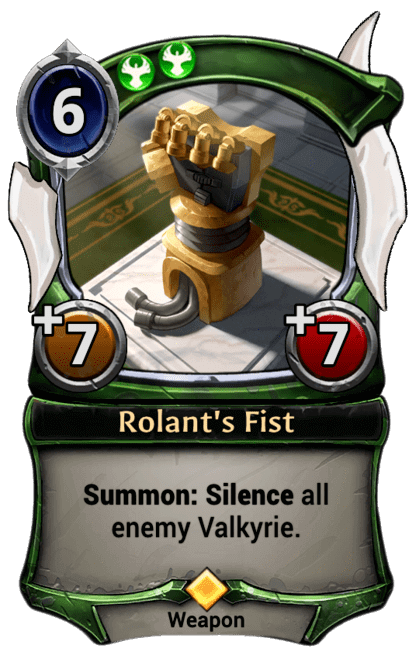
Credit to TEJ for the obvious joke.]
However, the grindy value game plan of the Vision Midrange builds just felt too slow to effectively counteract the current versions of Overloader Combo, and just couldn’t outgrind most iterations of the Sling deck since they were particularly lacking in relic removal. Playing Sling, I was ecstatic whenever I faced this on Day 1 – I don’t believe I dropped a game against any JSx Midrange deck. Since I expected those decks to be some of the most popular options on Day 1, I, unfortunately, had to abandon my simpee for this tournament. I might go back if the metagame becomes less hostile to it, but as it turns out, when you can play more broken and powerful cards for a cheaper influence requirement, you go do that. XD
Balance Changes: Our thoughts!
(SG: Look, they’re very late, but do you think that’s going to ever stop me? Fat chance.)
Though the balance changes are mostly targeted towards Draft, there are a couple of spicy additions to the Draft packs that are certainly worth taking a gander at.
- Kaleb’s Intervention gives the non-Time Condemn markets such as that of Overloader Combo a way to answer Sling. You probably don’t need it, but it’s nice to have that option.
- Blackhall Warleader in the format is going to be a pretty solid inclusion in the aggressive Shadow decks – if you’ve played against that card in Throne, it snowballs so quickly when unanswered. However, since it does take a while to get going, it may be a pinch too slow in the face of combo. The stats remain when you buy it back with Krull, which is always nice. In a similar vein, Lethrai Target Caller is another decent option for decks that are reliably able to get double Shadow influence on Turn 2. You’ve got the Menace Krull deck as well as a Stonescar Heavy-S list that made some waves, so these are both solid options for the 2 drop slot.
- It might be a pinch too slow, but Zuberi offers the Mono F some additional ways of making ridiculously high strength units to Overwhelm with. Natural Overwhelm on Siege Train is nice, but I could definitely see this having some potential in that 4 drop slot. Double Damage Belaxes, anyone?
- Calibrate and Cryptic Master might finally be the push that the relic decks need to be viable in the format – particularly with the recent buffs to Cryptic Master. I’m not yet quite sure how I’d balance the aggression and value relic cards that we have access to, but there’s certainly plenty of powerful synergies to be had.
- My children are finally here! Back when I first started playing Eternal casually way back when, the first Legendaries I crafted was a set of Crown of Possibilities. The 2nd was a set of Breeze Dancer. (Look, SG likes chaos. Lots of it.) With these, I might finally be able to piece back together my nostalgic 2017 Chalice Crown deck – whether it’s any good is a different question.
- In a similar vein, my first Expedition deck back when the format was first introduced was an Elysian Midrange deck just playing all the good Elysian card, and Amaran Armadillo did WORK. Nowadays, I’m most excited to jam this in my Chalice lists to ready my buffed up units right after I Chalice them. 😉
Final thoughts:
With the new set Revelations dropping in less than a week, I’m super excited to see what fun new decks arise in Expedition. I, for one, am excited to see Sling rotate out of the format. The card is very powerful and very difficult to interact with (part of why I chose to play it in the Open, heh), which means it’s probably too strong for the Expedition format. There’s still plenty of powerful cards from the new set, (hello Davia – what spicy spells will they let you buyback?), and I’ve already got my brewing fingers all ready to go.
A side note: I’m financially solvent enough that I don’t need to earn money from subs or Patreon or what have you by writing these articles. All I need is my keyboard and my laptop, so there’s not much I can do to upgrade my set-up anyways. That being said, everyone who has agreed to collaborate with me thus far – SRFS, TheBoxer and Stormblessed – have agreed to do so completely out of goodwill and wanting to impart their wisdom and insight to the community. So. If you appreciated their insight on anything and wish to support them and all the other content they make, please do so. Literally all of them are affiliated to a podcast, so that’s certainly an option. If you’re not comfortable getting in touch with them directly and wish to support their content through me, please also let me know. That probably also increases the odds that they’ll rock-up to the articles again, so there’s that. ^-^
Did you whole-heartedly agree with what Stormblessed is saying and want to just diss me on the side in the process? Are there any cards from Revelations that you’re just chomping at the bit to brew around? You can find both of us lurking in the FE Discord, where you’ll also be able to catch the latest episodes of Stormblessed on the FE Cast. You can also find me over on Twitter @stormguard798, or lurking around The Misplay and TEJ Discords as well. Until next time. 😉
 Careful Considerations - Ramblings of an Aspiring Azorius Lawmage